


Before a creditor can seize the funds in your bank account, they must navigate a specific legal process. A bank levy does not happen arbitrarily; it is the final stage of a prolonged collection effort.
The process begins when a creditor—such as a credit card company, medical provider, or debt buyer—files a civil lawsuit against you. Depending on the debt’s size, these lawsuits are filed in the Special Civil Part (for claims of $20,000 or less) or the Law Division (for claims exceeding $20,000). If you fail to file a formal, written response to the summons and complaint within 35 days, the court will likely enter a default judgment against you. This “civil money judgment” acts as a formal judicial declaration verifying the exact amount you owe.
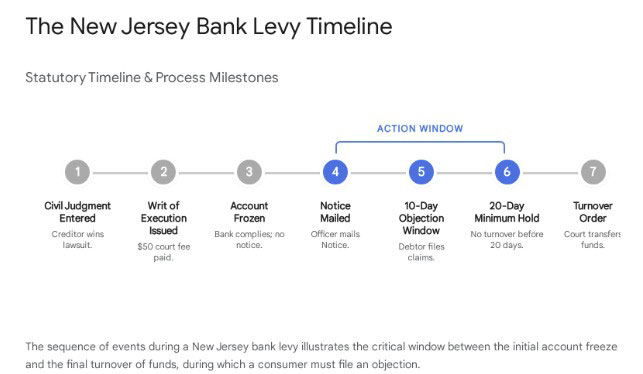
Once armed with this judgment, the creditor transforms into a “judgment creditor” and gains the legal authority to enforce the debt. They apply to the court for a Writ of Execution, paying a $50 filing fee. This writ legally authorizes a county sheriff or Special Civil Part court officer to locate and levy your assets.
The Element of Surprise and the Account Freeze
The most jarring aspect of a New Jersey bank garnishment is its suddenness. Under New Jersey law, creditors are not required to provide you with any advance notice before levying your bank account. This deliberate procedural rule exists to prevent debtors from preemptively withdrawing or hiding their funds upon learning of an impending levy. Consequently, the first indication you may receive is a declined debit card transaction at the grocery store or a notification of bounced checks.
When the sheriff serves the Writ of Execution on your financial institution, the bank is legally obligated to freeze the funds up to the judgment amount. The levying officer identifies your account by providing the bank with your name, address, and the last four digits of your account number.
The Turnover Process and Your Window to Act
It is a common and dangerous misconception that your frozen money is instantly transferred to the creditor. During the initial freeze, your funds remain securely held at your bank. To actually collect the money, the judgment creditor is required by N.J.S.A. 2A:17-63 to file a formal “Motion for Turnover of Funds” with the court.
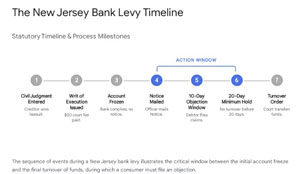
New Jersey Court Rules enforce strict waiting periods to ensure due process. Specifically, no turnover of funds may occur until at least 20 days after the date of the levy. During this critical window, the levying officer must mail an official Notice to Debtor, informing you of the levy and your rights to claim legal exemptions. The creditor must also serve you and the bank with the turnover motion. This procedural pause is your opportunity to file an objection, seek legal counsel, and stop the garnishment before the assets are permanently lost.
| Bank Garnishment Phase | Description | Legal Timeframe / Requirement |
| Writ of Execution | Creditor obtains court authorization to target assets. | Requires a valid civil money judgment and a $50 fee. |
| Account Freeze | Sheriff serves the bank; funds become inaccessible. | No advance notice is provided to the debtor. |
| Notice to Debtor | Official notification is mailed to the debtor outlining the levy. | Must be sent by the levying officer after the freeze. |
| Objection Window | The period during which a consumer can formally fight the levy. | 10 calendar days from receipt of the Notice to Debtor. |
| Turnover Motion | Creditor asks the court to transfer the frozen funds. | No turnover can occur until at least 20 days post-levy. |
Legal Exemptions to Protect Bank Account Funds
When fighting a bank levy, your primary defense involves asserting statutory exemptions. Both federal and state laws recognize that a creditor cannot render a debtor entirely destitute. Specific categories of income are legally shielded from judicial seizure, ensuring individuals maintain a baseline for survival.
Federal and Source-Specific Protections
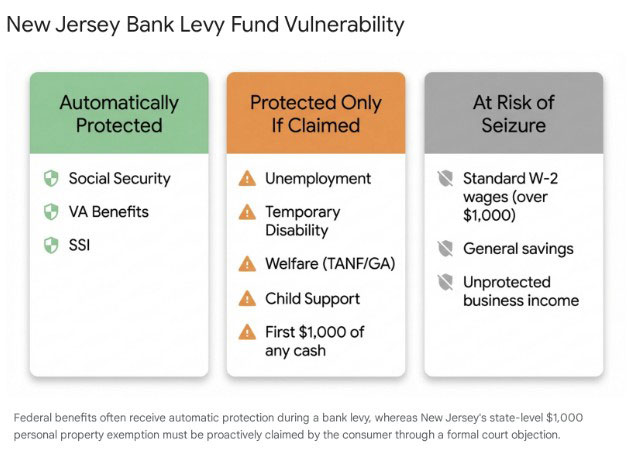
Income derived from specific governmental or social safety net programs is entirely exempt from a civil money judgment levy. Consumers must fiercely protect these funds. Universally protected income sources include:
- Social Security Benefits: Retirement, SSDI, and SSI payments are highly protected. Federal banking regulations require financial institutions to perform a two-month “lookback” review when served with a writ to automatically protect electronically deposited federal benefits without requiring the debtor to take immediate action.
- Veterans’ Benefits: Financial support provided to veterans is strictly exempt from creditor attachment.
- Unemployment and Disability: New Jersey State Temporary Disability and unemployment benefits are shielded from collection to protect out-of-work individuals.
- Public Assistance: Welfare funds, including General Assistance (GA) and Temporary Assistance for Needy Families (TANF), are fully exempt.
- Child Support: Funds originating from child support payments are protected from consumer debt levies.
The New Jersey Personal Property Exemption (N.J.S.A. 2A:17-19)
For funds that do not originate from protected government programs—such as standard employment wages deposited into a checking account—New Jersey offers a critical statutory protection. Under N.J.S.A. 2A:17-19, every individual in the state is entitled to a $1,000 exemption from levy on any personal property.
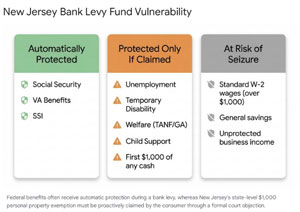
Because the law classifies cash and bank account balances as personal property, a debtor can proactively assert this wildcard exemption to protect the first $1,000 in their frozen bank account.1 However, unlike the automatic protection afforded to Social Security benefits, this $1,000 state exemption is not self-executing. The bank will freeze the entire account balance, and the consumer bears the burden of affirmatively claiming this exemption through a formal court objection.
Transformative Protections: The Louisa Carman Medical Debt Relief Act
The landscape of debt collection in New Jersey is undergoing a massive shift regarding healthcare-related judgments. The Louisa Carman Medical Debt Relief Act (P.L. 2024, c. 48), fully operational on July 22, 2025, drastically curbs the ability of medical providers and debt buyers to execute aggressive collection actions.
For consumers facing bank levies specifically tied to medical debt, this legislation provides unprecedented defenses. The Act strictly prohibits the garnishment of wages for any patient whose household income falls below 600% of the federal poverty level—a threshold protecting a vast majority of middle-income residents (approximately $180,000 for a family of four in 2025).16 Furthermore, medical creditors are legally barred from initiating lawsuits or executing levies while an internal or external health insurance appeal is pending.
Additionally, the Act caps the post-judgment interest rate on medical debts at a mere 3% per year, neutralizing the rapid inflation of judgment balances that typically occurs under standard New Jersey post-judgment rules.16 Any medical debt reported to a credit bureau in violation of these new provisions is deemed legally void, and the state Attorney General possesses the authority to mandate the restitution of any funds unlawfully seized.
How to Stop Bank Garnishment in New Jersey
Upon discovering a frozen account, you must immediately implement a legal strategy to prevent the turnover of your funds. Ignoring the situation guarantees the creditor will successfully extract your money.
1. File an Objection to the Bank Levy
The most immediate method to stop a bank garnishment is to file a formal objection. According to New Jersey civil procedure, an account holder possesses exactly 10 calendar days from the receipt of the official Notice to Debtor (or the turnover motion) to file a written objection with the court.
To file an objection, you must complete a “Certification in Objection to Levy” (utilizing form CN 12323 for Special Civil Part cases). The objection must state valid legal grounds, typically asserting that the frozen funds originate from exempt sources, such as Social Security, child support, or the $1,000 personal property exemption. The court requires documentary evidence; you must attach three months of prior bank statements to prove the exact source and traceability of the exempt funds.
There is no filing fee to submit an objection to a bank levy in the Special Civil Part.1 Once the objection is submitted via the Judiciary Electronic Document Submission (JEDS) system or delivered to the local vicinage clerk, and formally served upon the creditor’s attorney, the court will schedule a hearing. If the judge verifies your exemptions, an order is issued directing the bank to release the freeze, restoring your access to the money.
2. File a Motion to Vacate a Default Judgment
While an objection hearing determines if specific funds are exempt, it does not address the validity of the underlying debt. To entirely invalidate the garnishment and attack the root cause, you must file a Motion to Vacate the Default Judgment under New Jersey Court Rule 4:50-1.16
New Jersey courts inherently prefer that civil lawsuits be resolved on their actual merits. A motion to vacate asks the judge to erase the judgment and rewind the lawsuit. To succeed within one year of the judgment’s entry, you must demonstrate two elements:
- Excusable Neglect: A justifiable reason for failing to file a written answer within the original 35-day deadline (e.g., severe medical emergencies or unavoidable misunderstandings).
- Meritorious Defense: A legitimate legal reason why the debt is invalid, such as the expiration of the statute of limitations. In New Jersey, general breach of contract claims face a six-year limit, while store-branded retail credit cards may be subject to a strict four-year limit.
Furthermore, if you can prove you were never properly served with the initial lawsuit, the judgment is classified as a “void judgment”. Void judgments carry no time limit for vacating and can immediately halt any associated bank garnishments.16
3. Utilize the Automatic Stay Through Bankruptcy
When debts are insurmountable, filing for bankruptcy provides absolute, immediate relief. The moment you file a bankruptcy petition, a federal injunction known as the “automatic stay” (11 U.S.C. §362) goes into immediate effect.16 This stay paralyzes all state-level collection activities, forcing creditors and sheriffs to halt active bank levies and wage garnishments.
Strategies to Settle Judgments New Jersey Consumers Can Use
Avoiding a bank levy entirely is the optimal scenario. Consumers who discover an active judgment against them should proactively explore settlement options before a writ of execution is finalized.
Once a judgment is entered, it rapidly accrues post-judgment interest, inflating the debt. Creditors are often highly motivated by the certainty of immediate cash versus the lengthy, expensive, and unpredictable process of attempting to levy assets. Consumers can often settle judgments new jersey courts have issued by negotiating a lump-sum settlement for a significantly reduced percentage of the total balance.
Alternatively, creditors may agree to structured voluntary payment plans. When a payment plan is agreed upon, the creditor formally stipulates that they will not execute bank levies or wage garnishments as long as the monthly installments are met. Your leverage in these negotiations increases dramatically if you actively defend yourself by challenging the creditor’s chain of title or filing a motion to vacate. Once a negotiated settlement is fully paid, the creditor is legally obligated to file a “Warrant of Satisfaction” with the court, officially clearing the judgment from the public record.
Why Hire Cannon Legal PLLC for Debt Defense?
Navigating civil procedure, statutory exemptions, and aggressive debt buyers requires sophisticated legal acumen. Operating out of Newark, New Jersey (One Gateway Center), Cannon Legal PLLC has established itself as a premier shield for consumers and small business owners facing severe financial distress.20
The firm’s New Jersey Managing Attorney and lead trial counsel, Dennis Giacomo Vilella, Esq.—known as “Jack” to his clients—brings over 15 years of hard-fought experience in consumer defense and commercial litigation.20 Admitted to the New Jersey Bar, Jack is recognized for his fearless approach and relentless advocacy in the courtroom.20 His professional philosophy is rooted in standing up for the underdog and bringing clarity to overwhelming financial crises.
Cannon Legal PLLC does not merely react to creditor actions; the firm implements aggressive counter-litigation strategies. The legal team meticulously enforces consumer rights under the Fair Credit Reporting Act (FCRA) and files lawsuits against abusive collectors who violate the Fair Debt Collection Practices Act (FDCPA).20 Furthermore, the firm specializes in defending small businesses targeted by predatory Merchant Cash Advances (MCA), providing the strategic arbitration and litigation necessary to break free from toxic lending.20 Whether executing a motion to vacate a default judgment, opposing an active bank levy, or guiding a client through complex bankruptcy proceedings, Cannon Legal PLLC provides the unwavering commitment necessary to reclaim your financial freedom.
Conclusion
A New Jersey bank garnishment is an incredibly stressful event that demands a swift, calculated response. Creditors rely on the element of surprise and consumer inaction to successfully extract funds via turnover orders. However, the legal system provides robust mechanisms to fight back. By quickly asserting statutory exemptions—such as the $1,000 personal property protection or the shielding of federal benefits—consumers can effectively stop a bank garnishment and unfreeze their essential assets.
Furthermore, implementing broader strategies to vacate default judgments or negotiate settlements can permanently neutralize the threat of future levies. For those overwhelmed by aggressive debt buyers or impending financial ruin, proactive legal intervention is paramount. Do not face aggressive creditors alone. Hiring the experienced legal team at Cannon Legal PLLC ensures your rights are protected, abusive collectors are held accountable, and you have a dedicated advocate fighting to secure your financial future.
Frequently Asked Questions (FAQs)
Can a bank account be garnished without notice in NJ?
Yes, creditors can freeze your account without advance notice in New Jersey. This prevents you from moving assets. You typically find out when transactions fail. Afterward, the levying officer mails an official Notice to Debtor, triggering your 10-day window to file an objection.
How long do I have to object to a bank levy?
You have exactly 10 calendar days from receiving the official Notice to Debtor or the turnover motion to file a written objection with the court. If you miss this strict deadline, the court usually orders the bank to permanently transfer your funds to the creditor.
What funds are exempt from garnishment?
Protected funds include Social Security, Veterans’ benefits, state temporary disability, unemployment compensation, child support, and welfare assistance. Furthermore, New Jersey allows a $1,000 personal property exemption applicable to cash in your account, but you must affirmatively claim this protection through a formal court objection.
How can I settle a judgment?
You can negotiate directly with the creditor or their attorney to pay a lump sum for less than the full balance, or you can establish a monthly payment plan. Once fully paid, the creditor files a Warrant of Satisfaction to officially close your case.