


A wage garnishment is a court-ordered mechanism that allows a creditor to take a portion of your paycheck directly from your employer. However, for standard consumer debts like credit cards, personal loans, or old apartment leases, a creditor cannot simply call your employer and demand money.
The process requires the creditor to first file a civil lawsuit against you in the New Jersey Superior Court. If you fail to respond to the lawsuit within the 35-day deadline, the court will enter a default judgment against you. Once the creditor secures this judgment, they can apply for a writ of wage execution.
Before the garnishment begins, the creditor must send you a Notice of Application for Wage Execution. This notice gives you a brief 10-day window to file a formal objection with the court. If no objection is filed, or if the judge denies your objection, the court signs an Order and Execution Against Earnings. A Special Civil Part Officer or County Sheriff then serves this order on your employer, who is legally obligated to withhold the specified funds and send them to the court officer.
Exceptions: Administrative Wage Garnishments
While most creditors need a judgment, certain state and federal entities can garnish your wages administratively—meaning they do not need to sue you first. These include:
-
Unpaid Taxes: The IRS and the State of New Jersey can levy your wages directly for tax arrears.
-
Federal Student Loans: The Department of Education can garnish up to 15% of your disposable income for defaulted federal student loans after giving you a 30-day notice.
-
Child Support and Alimony: Domestic support obligations take top priority and can result in garnishments of up to 50% to 60% of your disposable earnings.
Legal Limits: The New Jersey 10-25 Rule Explained
If a creditor successfully obtains a wage execution order, they are heavily restricted in how much they can take. New Jersey law provides highly protective formulas to ensure you have enough money left over to survive.
Under federal law, creditors can garnish up to 25% of your disposable earnings, or the amount your earnings exceed 30 times the federal minimum wage. However, New Jersey enforces a stricter, three-pronged formula known as the “10-25 Rule” (N.J.S.A. 2A:17-56).
The 3-Step Calculation
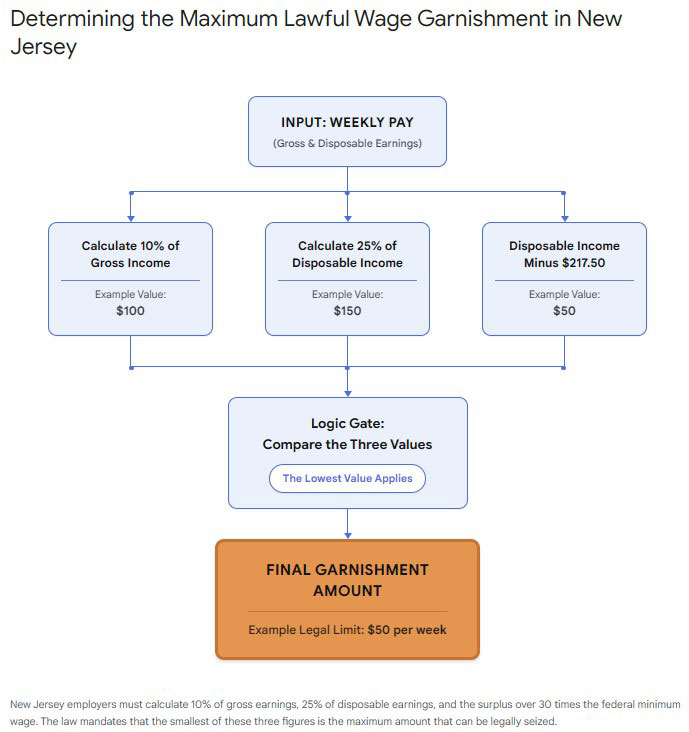
Under New Jersey law, your employer must calculate three different amounts for each pay period. The law mandates that the lowest of these three figures is the maximum amount the creditor can legally garnish.
-
10% of your gross income: This is your total pay before any taxes or deductions are taken out.
-
25% of your disposable income: Disposable income is your take-home pay after legally required deductions (like federal, state, and local taxes, and Social Security) are removed. Voluntary deductions, like 401(k) contributions or union dues, are not subtracted when calculating this figure.
-
The Minimum Wage Threshold: This is the amount your weekly disposable income exceeds 30 times the federal minimum wage ($7.25/hour x 30 = $217.50). If your weekly take-home pay is $217.50 or less, creditors cannot garnish anything.
The 250% Federal Poverty Level Exemption
New Jersey provides a powerful extra layer of protection for low- and moderate-income residents. If your total household income is below 250% of the Federal Poverty Level (FPL) for your family size, your wage garnishment is strictly capped at 10% of your gross income—even if the 25% calculation would be lower.
To illustrate, here is how the 250% exemption looks based on the 2026 Federal Poverty Guidelines :
| Family Size | 2026 Base FPL | 250% FPL Exemption Threshold |
| 1 Person | $15,960 | $39,900 |
| 2 Persons | $21,640 | $54,100 |
| 3 Persons | $27,320 | $68,300 |
| 4 Persons | $33,000 | $82,500 |
If you are a single earner making under $39,900 a year, creditors are legally barred from taking more than 10% of your gross pay.
Income Completely Exempt from Wage Execution
Regardless of the math, certain types of income are 100% immune from consumer debt garnishments in New Jersey. Creditors cannot seize funds derived from:
-
Social Security Retirement and SSDI
-
Supplemental Security Income (SSI)
-
Veterans’ Benefits
-
Unemployment and Temporary Disability Benefits
-
Workers’ Compensation
-
Welfare assistance, including TANF and General Assistance
2026 Updates: Medical Debt and Wage Garnishment
In a monumental shift for consumer rights, the New Jersey legislature passed the Louisa Carman Medical Debt Relief Act (P.L. 2024, c. 48), which fully applies to debt collection actions in 2026. Because medical debt is largely involuntary, this law aggressively restricts how hospitals and third-party medical debt buyers can collect from you.
Key 2026 protections under the Act include:
-
A Complete Ban on Wage Garnishment for Protected Incomes: Medical creditors are legally prohibited from garnishing your wages if your annual income is less than 600% of the Federal Poverty Level. For a single individual in 2026, this means you are entirely immune from medical wage garnishment if you earn under $95,760 a year.
-
Credit Reporting Ban: Medical debt collectors can no longer report your medical debt to consumer reporting agencies (Equifax, Experian, TransUnion). Any debt reported in violation of this law is void.
-
Mandatory Payment Plans: Collectors cannot take legal action until 120 days have passed since the first bill, and they must offer you a reasonable payment plan that does not exceed 3% of your monthly income.
-
Interest Rate Caps: Interest on medical debts is permanently capped at a maximum of 3% per year.
How to Stop Wage Garnishment in New Jersey
If your paycheck is actively being garnished—or if you have received a notice that garnishment is imminent—you must take immediate legal action. Here are the four primary strategies to protect your income.
1. File an Objection to the Wage Execution
When you receive the Notice of Application for Wage Execution, you have exactly 10 calendar days to file a written objection with the court (or 15 days if the notice was mailed to you). You must file a Certification in Objection to Wage Garnishment, which stops the order from going to your employer until a judge hears your case.
You can object on the grounds that your income comes from exempt sources (like Social Security), that the calculation violates the 10-25 rule, or that the garnishment creates an extreme financial hardship (such as preventing you from paying for a sick dependent’s medical care).
2. Vacate the Default Judgment
Wage executions rely on the underlying court judgment. If you never responded to the original lawsuit—perhaps because you were never properly served the court papers, or you were dealing with a medical emergency—you can file a Motion to Vacate the Default Judgment.
To win this motion, you must prove “excusable neglect” (a valid reason you missed the deadline) and a “meritorious defense” (a legal reason why you don’t owe the debt, such as identity theft or an expired statute of limitations). If the judge grants the motion, the judgment is erased, and the wage garnishment is instantly terminated.
3. Settle Judgments in New Jersey
If the debt is valid, the most practical way to stop the bleeding is to negotiate directly with the judgment creditor. Collection agencies know that garnishing 10% of your paycheck over several years is a slow, risky process. By hiring a skilled attorney, you can often negotiate a lump-sum settlement for significantly less than the full balance owed.
Alternatively, you can agree to a structured voluntary payment plan. Once an agreement is reached, the creditor will file a stay of execution, stopping the garnishment. Once the settlement is fully paid, the creditor must file a Warrant to Satisfy Judgment, officially clearing the lien from your record. For professional assistance in negotiating these complex agreements, you should explore how to settle judgments new jersey through strategic legal intervention.
4. File for Bankruptcy to Trigger the Automatic Stay
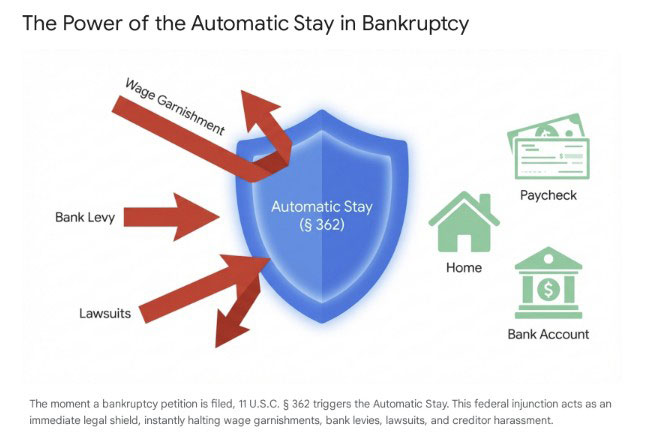
When debts are insurmountable and creditors refuse to negotiate, filing for bankruptcy is the ultimate shield. The moment you file a Chapter 7 or Chapter 13 bankruptcy petition, federal law triggers an immediate injunction known as the Automatic Stay (11 U.S.C. § 362).
The automatic stay instantly forces all creditors to stop collection activities. Lawsuits freeze, bank levies are released, and your employer is legally barred from withholding any more money from your paycheck for consumer debts. Chapter 7 bankruptcy can completely wipe out the underlying debt within a few months, ensuring the garnishment never returns, while Chapter 13 allows you to consolidate arrears into a protected repayment plan.
Why Hire Cannon Legal PLLC to Defend Your Paycheck?
Trying to navigate the Special Civil Part of the New Jersey court system while dealing with the financial trauma of a reduced paycheck is overwhelming. Debt buyers and collection agencies have teams of lawyers dedicated solely to extracting money from you. To protect your income, you need an advocate who can level the playing field.
Led by New Jersey Managing Attorney Dennis Giacomo “Jack” Vilella, Esq., Cannon Legal PLLC operates out of Newark, NJ, with a singular mission: to act as a shield for everyday consumers and small business owners against aggressive creditors. Jack brings over 15 years of hard-fought trial experience to the table, utilizing a fearless approach to stop judgment collections and fight back against predatory lenders.
When you hire Cannon Legal PLLC, you benefit from a firm that specializes in:
-
FDCPA and FCRA Enforcement: Suing debt collectors who cross the line into harassment and forcing credit bureaus to correct unlawful reporting.
-
Aggressive Litigation Defense: Vacating default judgments and challenging major debt buyers like Midland Credit Management, Portfolio Recovery Associates, and LVNV Funding in court.
-
Strategic Debt Relief: Negotiating favorable judgment settlements to keep your money in your pocket, and providing expert bankruptcy representation to trigger the automatic stay.
-
Small Business Protection: Providing specialized defense against toxic Merchant Cash Advances (MCAs) that threaten your livelihood.
Conclusion
A New Jersey wage garnishment is a serious financial emergency, but it does not have to ruin your life. Whether you need to file an immediate hardship objection, vacate a default judgment, negotiate a strategic settlement, or seek the absolute protection of a bankruptcy automatic stay, you have powerful legal tools at your disposal.
Do not let a debt buyer seize your hard-earned wages without a fight. If you are ready to stop wage garnishment and reclaim your financial freedom, you need a relentless advocate on your side. Take action today by contacting Cannon Legal PLLC at (201) 582-8450 to schedule your consultation and build your defense strategy.
Frequently Asked Questions (FAQs)
What is the maximum amount a creditor can garnish from my paycheck in NJ?
In New Jersey, creditors can legally garnish the lesser of 10% of your gross pay, 25% of your disposable pay, or the amount your disposable pay exceeds $217.50 weekly. However, if your income falls below 250% of the federal poverty level, garnishments are strictly capped at 10%.
Can my employer fire me for having a wage garnishment?
No, your employer cannot fire you because of a wage garnishment. New Jersey law and federal regulations strictly prohibit employers from terminating, disciplining, or discriminating against an employee simply because their earnings are subject to a wage execution or garnishment order from a creditor.
How long does a creditor have to collect a judgment in NJ?
Once a civil judgment is officially docketed in New Jersey, it remains valid and enforceable for 20 years. During this time, the judgment creditor can actively pursue wage executions, bank levies, and property liens. Additionally, creditors have the legal option to renew the judgment.
Will filing for bankruptcy stop my wage garnishment?
Yes, filing for bankruptcy stops wage garnishment immediately. The moment you file, federal law triggers an automatic stay. This injunction forces creditors to halt all collection activities instantly, meaning your employer must immediately stop withholding wages for consumer debts and judgments.